
Most marketing tools have the memory of a goldfish.
They show you this month. Maybe last month too, if you find the right toggle. But they don't remember anything. They don't know the March dip was the week your biggest channel changed its algorithm. They don't know the campaign that looks mediocre is the one that seeds your big deals three months later.
You open the dashboard and it greets you like a stranger. Every time. And the remembering, the connecting, the noticing, that all falls back on you. On you and whatever you scribbled down at the time, which let's be honest is nothing.
So that's the thing Agentcroft Insights actually fixes. Not the dashboards. The brain underneath them. And it's the bit I'm proudest of by a mile.
What do I mean by a brain. Fair question, the word gets thrown about. I mean it holds thousands of data points across every channel and keeps them in context. Not rows in a table. A picture of how your business actually behaves. It remembers. It watches the same numbers month after month until it knows what normal looks like for you, specifically, so when something moves it can tell you if that's noise or if you should care.
And it works out cause and effect. The thing you did in January and the thing that happened in March. That link. The one a human mind is far too busy and too forgetful to hold across a whole year.
That last part is the hard one.
Joining your data up? Solvable. Loads of tools stitch channels together, fine. But here's what nobody says out loud: joined-up data still just sits there. A table that agrees with itself isn't an insight. It's a tidy table.
What you actually want is something that looks at the whole mess and goes, right, this pattern keeps showing up, that swing last month was caused by this, and I'd put the next pound here. That's not reporting. That's judgement. And judgement is the thing nobody had managed to get into software for marketers.
We tried the obvious route first. The Lookers, the Power BIs. Powerful tools. They also hand you an empty dashboard and a hiring problem, because the intelligence was never in the tool, it was in the analyst you had to hire to run it. So we put the intelligence in the tool. And it gets sharper about your marketing every month it runs, which the analyst, bless them, did not do for free.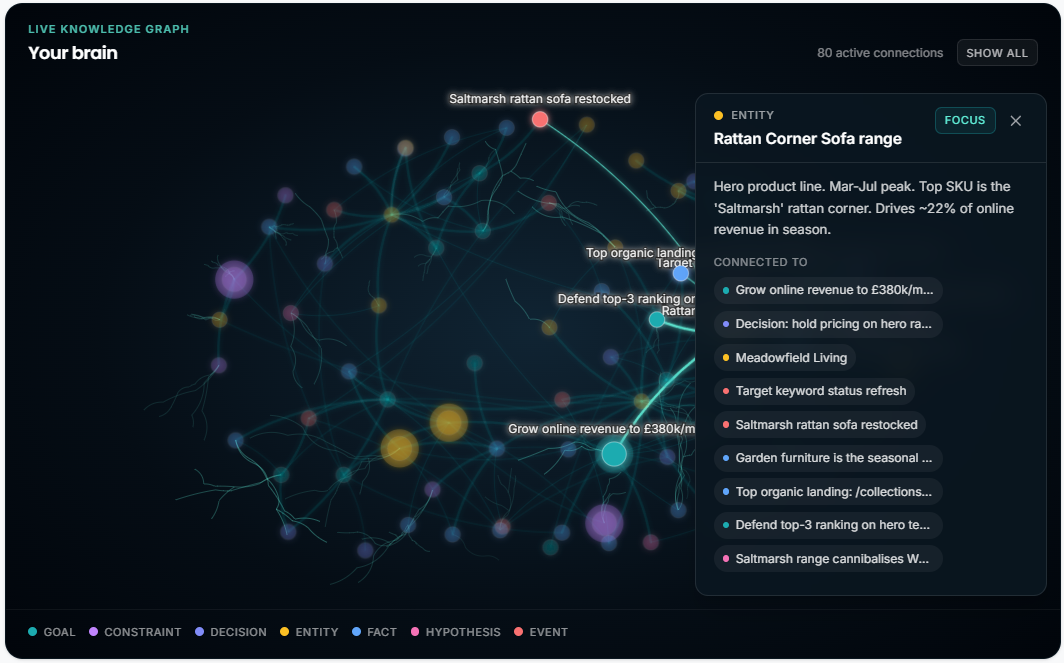
One thing I'll be straight about. It's a brain you can see. Not a black box that hands down a verdict and dares you to trust it. You can watch it reason. See the pattern it spotted, follow why it flagged what it flagged. When two channels tell you contradictory stories it shows you the contradiction instead of quietly picking a favourite. Because the goal was never a confident-sounding answer. It was an answer you could actually poke at, and then put your name on.
The moment that got me wasn't a chart.
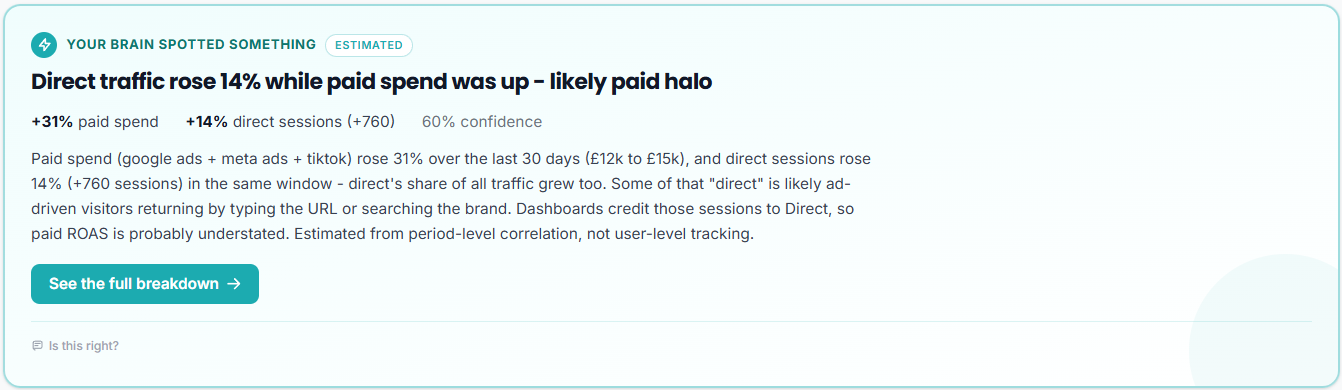
It was the brain telling a client something they didn't know about their own business. Two channels nobody on the team had connected, sitting there in plain English with the reasoning attached. Months of data, and the pattern had been hiding in it the entire time. Watching someone realise that is genuinely the whole reason I bothered.
So. If you've ever sat staring at a dashboard knowing the answer was in there and you just couldn't hold all of it in your head at once, yeah. That feeling. That's what this is for.
There's a live demo on real data. Go watch the brain work before you give it anything.
I'm so happy to finally show people. Have a look.